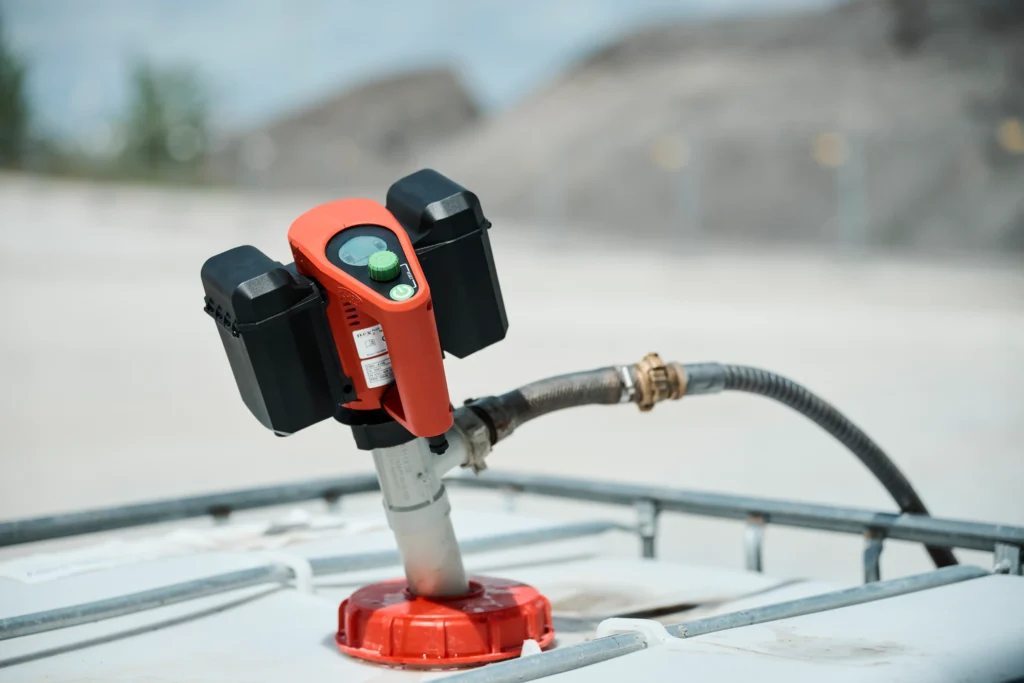
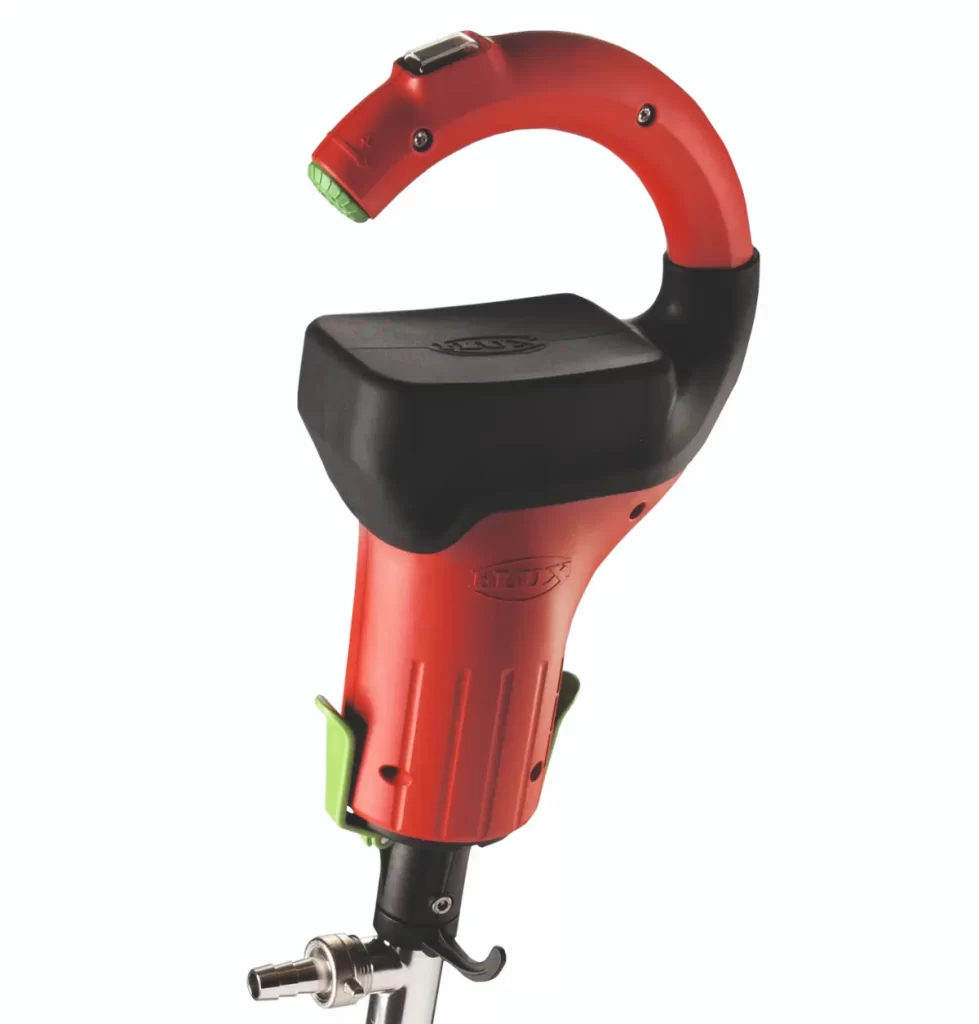
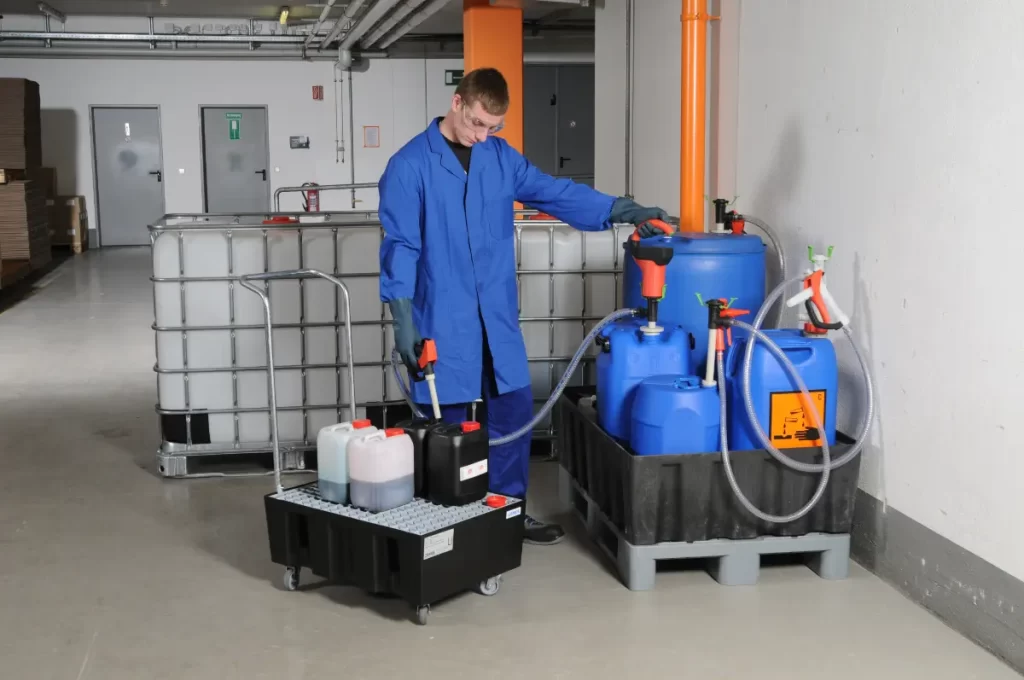
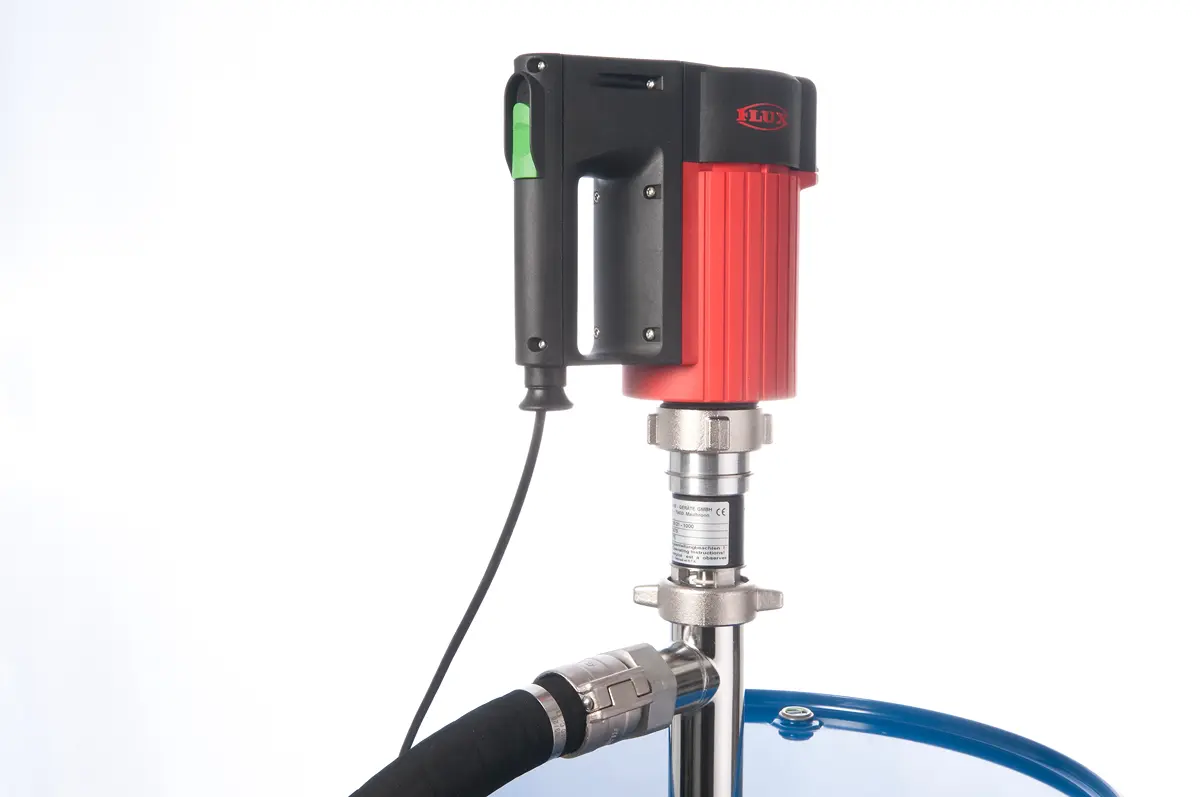
A battery drum pump is a portable, cordless solution for transferring common chemicals from barrels, IBCs and containers. Unlike mains-powered or pneumatic pumps, they do not require an external power source, making them ideal for remote locations, outdoor use, or applications where trailing cables can create a trip hazard.
Furthermore, while battery‑powered drum pumps remove the limitations of fixed power and compressed‑air systems, providing improved mobility and safety, they also add improved performance and functionality, along with lower noise levels.
This article explores the benefits of battery powered pumps in further detail.
Ten battery pump benefits
1. Move fluids anywhere
Battery powered drum pumps transfer liquids to any point of need: bunded areas, outdoor tanks, mezzanine floors or remote sites where mains power sockets or air lines are impractical. They can deliver high flow rates (up to 218 L/min) and high discharge pressure, so they can be used in a wide range of applications.
Furthermore, ventilated and fully enclosed FBM 4100 motors are available to suit different environments, so cordless operation does not mean compromised performance or longevity. Choose IP44 enclosed motors for tough environments containing steam or corrosive fumes and IP 24 ventilated motors for safe areas, when maximum performance is required.
2. Improve workplace safety
Elimination of trailing cables and long air hoses reduces slip‑and‑trip hazards. Lower weight along with ergonomic design makes manual handling easy and reduces the risk of accidental power disconnection. And of course, electric cables are not required, eliminating the possibility of cable damage and associated electrocution risks.
3. Intelligent features
The FBM 4100 motor incorporates switchable dry‑run protection that stops the motor automatically when the liquid supply runs out, protecting the pump bearings and preventing premature mechanical seal wear, or overheating. Six programmable batch filling timers deliver accurate, repeatable dosing, eliminating overfilling and waste, improving productivity and lowering costs over time.
4. Cost
As power and compressed air supplies are not required, savings can be made not only on infrastructure cost, but also ongoing air and electricity costs. Battery charge times are low and battery life surprisingly long, especially when using larger 8 Ah batteries. Furthermore, one quick-release cordless motor can be used to power multiple, product‑dedicated pump tubes, therefore reducing initial capital outlay. Dedicating a pump to individual product eliminates cleaning time and associated costs.
5. Installation speed and reduced downtime
Container changeover times are correspondingly shorter, increasing efficiency. For pilot runs, smaller R&D tasks, or short production runs, battery pumps enable rapid setup without the need for permanent piping or electrical installation work.
6. Increased mobility and flexibility
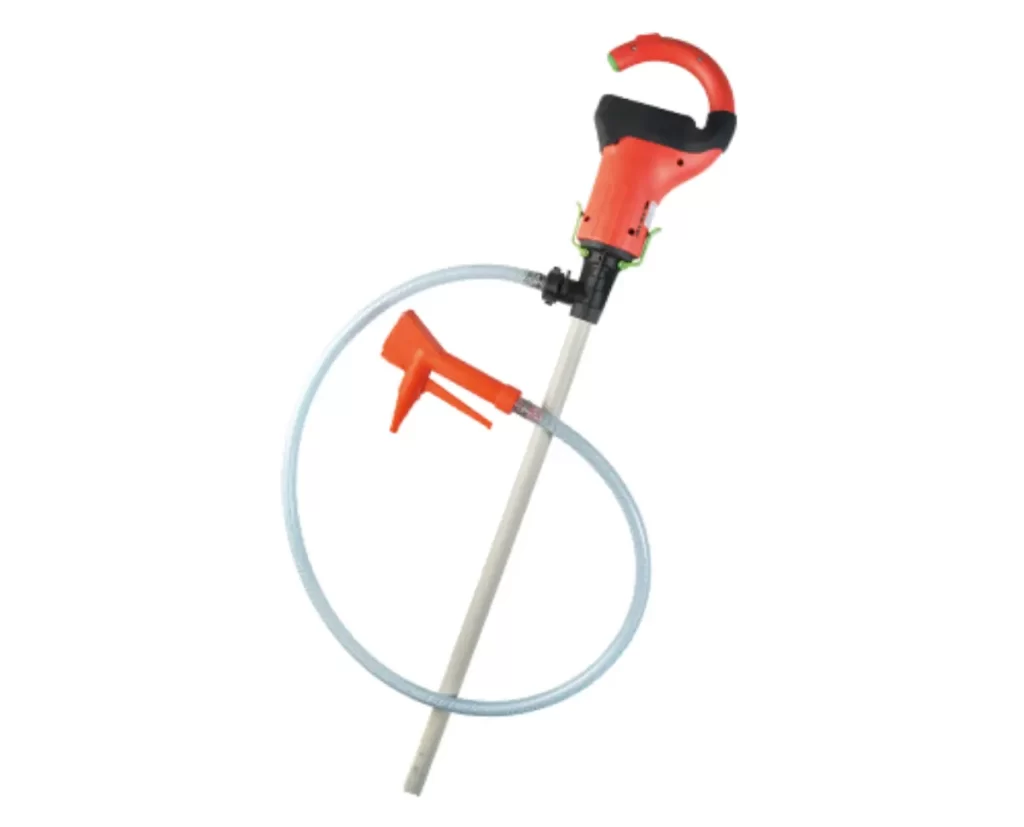
Technicians can carry a compact battery motor to the drum or IBC, rather than moving heavy containers, or running hoses or power cables across production areas. Pre-assembled, portable kits that include the motor, pump tube, discharge hose and hand nozzle simplify field based tasks, such as pumping disinfectants on remote water treatment plants, emergency spill‑response and routine sampling. Battery powered pumps reduce the time operators spend away from other critical work. Operational continuity is straightforward: keep spare batteries charged and rotate them during long shifts, multiple drum fills or IBC transfers.
7. Handle a wider range of fluids
Battery motors are compatible with multiple pump tube types, materials and geometries. This enables the safe transfer of a wide range of liquids, from low‑viscosity water-based chemicals up to heavy oils, or food products. This flexibility reduces the need for multiple dedicated pumps.
FBM 4100 battery motors are compatible with all F 400 series tubes, F 570 Viscopower tubes and many third‑party tubes (using adapters). We provide the flexible solutions you need to pump almost any product.
8. Improved dispense control
Variable speed control is fitted as standard. Select high flow setting when transferring large volumes and lower flow setting when dispensing into smaller containers to avoid spills. Six programmable batch filling timers provide accurate, repeatable dosing functionality, eliminating overfilling and waste, improving productivity and lowering costs over time.
9. Intelligent battery management systems and power packs
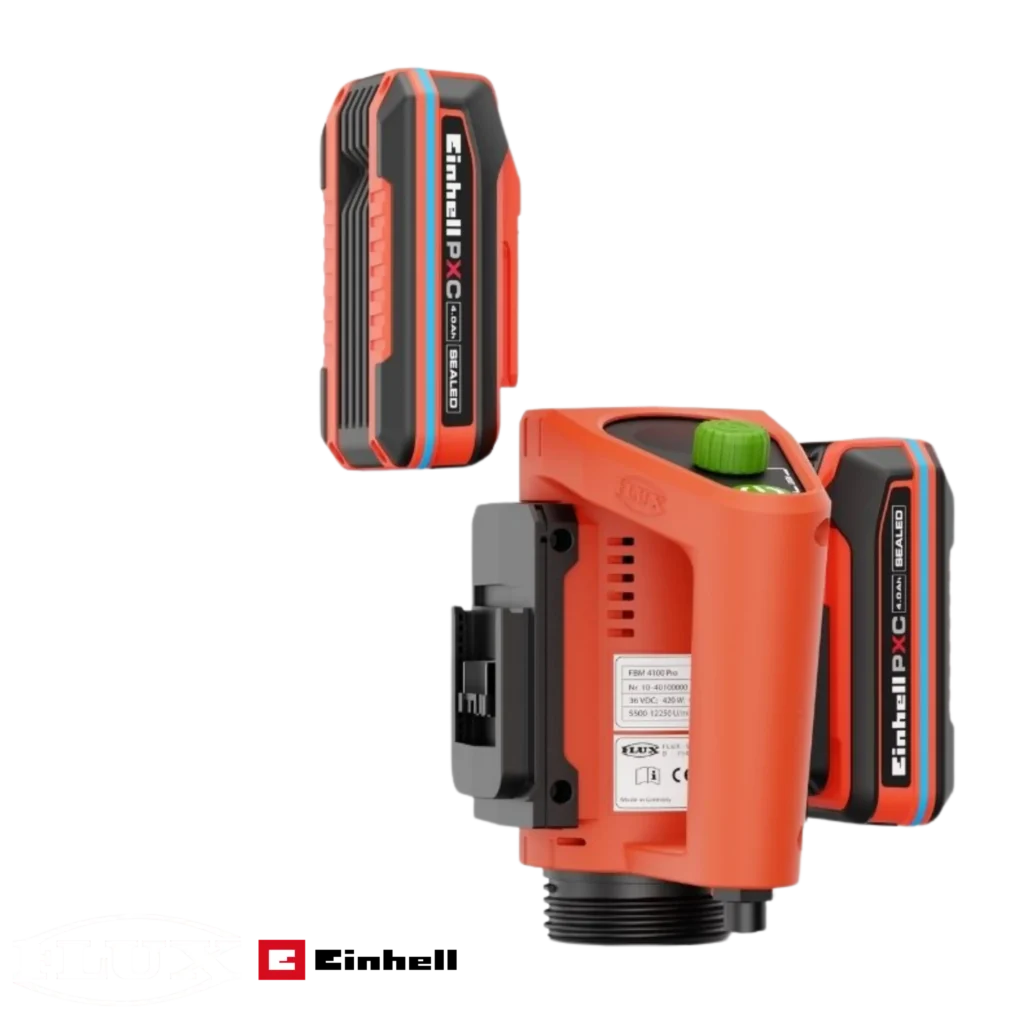
FBM 4100 requires two Einhell Power X‑Change 18 V batteries, providing ultimate performance. 4 Ah PLUS batteries are recommended for standard applications and larger 6 Ah or 8 Ah capacity batteries can be used for extended runtimes and high viscosity fluids. All Einhell accessories are compatible, including battery covers, car charger, X-fast charger and Quattrocharger.
10. Reduce maintenance costs and complexity
Brushless battery motors are largely maintenance‑free because they do not require carbon brushes and other wear parts. Maintenance costs can be reduced dramatically by combining a battery motor with a seal‑less pump tube, thanks to extended service intervals and the elimination of dynamic seals . Modular design, incorporating interchangeable motors and pump tubes, allows the motor to remain in use while pump tubes are repaired or serviced. This results in faster repair turnaround times.
Flux offers two battery powered drum pumps:
FBM 4100
High-capacity drive motor paired with F 400 series drum pump, for ultimate cordless performance combined with smart controls and long runtimes. FBM 4100 is a 36 V brushless motor, powered by 2 x Li-Ion batteries of capacity 4 Ah to 8 Ah, for extended runtime applications. These pumps deliver high flow rates up to 218 LPM and can be used to transfer high viscosity (< 800 mPas) and high density media (< 1.7 SG)
FBM 3100
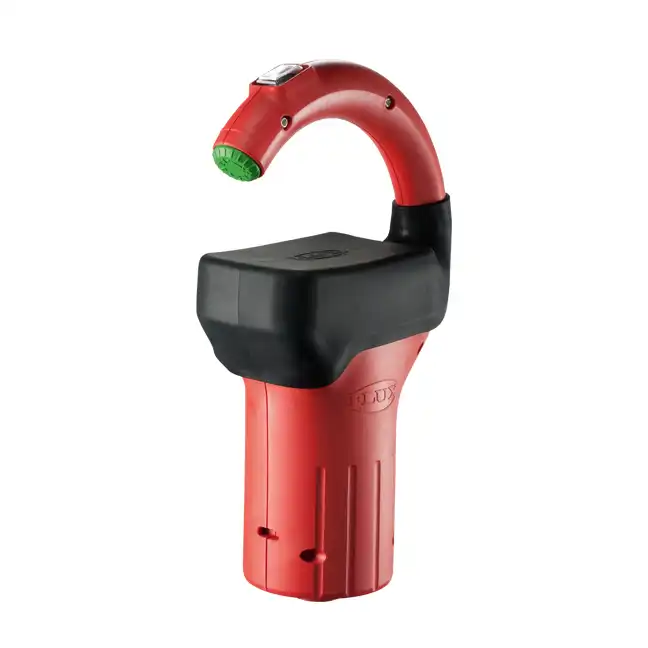
Ultralight 18 V drive motor with single 2.5 Ah battery, paired with Combiflux drum pump tube, for simple mobile, low-flow pumping tasks. An ideal solution for emptying smaller containers containing dilute acids, alkalis, oils and disinfectants, these pumps are in use with water authorities, hospitals, laboratories, swimming pools and also chemical processing plants throughout the world.
FBM 4100 and FBM 3100 motor comparison — concise technical specifications
Model
Power / Motor
Max flow / Pressure
Protection / Cooling
Battery / Runtime / Duty
FBM 4100 (ventilated)
36 V 420 W BLDC motor (S1 continuous duty)
Up to 218 L/min; up to 30 mWC
IP24 ventilated
Requires 2 x 4 Ah / 6 Ah / 8 Ah Einhell batteries. Heavy duty.
FBM 4100 (enclosed)
36 V 420 W BLDC motor (S2 – intermittent duty, 45 mins)
Up to 218 L/min; up to 30 mWC
IP44 enclosed, limited run time vs ventilated
Compatible with 4 Ah / 6 Ah / 8 Ah Einhell batteries. Heavy duty.
FBM 3100 (enclosed)
18 V 230 W BLDC motor (S1 continuous duty)
Up to 55 L/min, 8 mWC
IP44 enclosed
Requires 1 x Flux 2.5 Ah Li-Ion battery. Light duty
Key features explained (what these numbers mean for you)
Brushless motor efficiency and durability – Brushless (BLDC) motors deliver higher energy efficiency compared with conventional brushed motors, delivering more power and supporting longer runtimes while eliminating maintenance requirements.
Enclosure options – Choose the ventilated IP24 variant maximum run times. Choose the enclosed IP44 variants where dust, moisture, steam or corrosive vapour protection is a priority.
Flow – The FBM 4100 achieves flows up to 218 L/min in typical test conditions, enabling fast drum and IBC emptying for high‑throughput tasks. The lighter, smaller FMB 3100 motor delivers maximum flow rates of 55 LPM.
Duty – For heavy duty tasks, high flow, high pressure, handling larger volumes, mixing, or pumping higher viscosity and / or higher density liquids, select high power motor with F 400 series pump tube.
Recommended configurations by use case
High flow drum/IBC transfer – FBM 4100 ventilated + F 400 series pump with axial impeller, for fastest emptying and also heavy duty applications.
High pressure, outdoor or washdown environments – FBM 4100 enclosed (IP44) + F 400 series pump with semi axial (high pressure impeller).
R&D and small‑batch work – COMBIFLUX FP 314 with FBM‑B3100 battery motor. For shorter, low-volume, or narrow‑neck containers.
Battery Drum Pump FAQ’s
Why use a battery drum pump?
The latest 36 V battery motors for drum pumps offer class-leading power and extended battery life, making them suitable for demanding applications and frequent use. Innovative design features further improve portability and reliability, ensuring safe and efficient liquid transfer wherever needed.
The lightweight FBM 4100 motor weighs only 1.2 Kg and the ergonomic design allows one-handed operation, therefore reducing risk of operator injury and improving comfort during prolonged use. Brushless motor technology ensures consistent performance with minimal wear and tear. This results in longer service life, reduced maintenance and increased reliability.
Additionally, variable speed control allows the user to vary the flow rate and improve dispense control, thereby reducing waste and improving productivity. Furthermore, the modular design improves flexibility, letting you use the same motor with any matching pump tube. Therefore, battery motors provide a cost-effective and adaptable solution for different liquids and dispensing operations.
Moreover, FBM 4100 incorporates intelligent features such as dry-run protection and six programmable batch timers, for extended pump service life and cost-effective, accurate batch dispensing.
How does a rechargeable drum pump work?
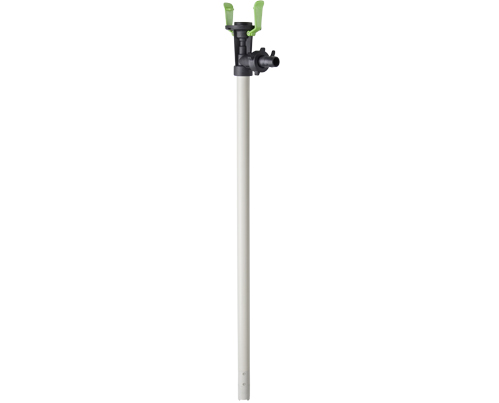
As with many barrel pump designs, a rechargeable drum pump consists of two main components, the battery motor and the pump tube. The motor drives the rotary pumping mechanism inside the pump tube. Most common battery powered drum pumps are centrifugal designs.
A rotating bladed impeller is mounted in the end of the pump tube. The impeller attaches to a long driveshaft that passes through the centre of the pump tube. A series of bearings support the driveshaft. The impeller rotates at high speed, therefore applying centrifugal force to the liquid and generating flow.
The impeller must be immersed in the fluid in order to create flow. The pump cannot “suck up” the liquid from a dry start, as it does not create a vacuum. It is not a self-priming pump. Therefore, operation relies on the force applied by atmospheric pressure and gravity to push liquid to the impeller.
Are there any disadvantages to using a battery drum pump?
While battery drum pumps remain subject to certain limitations, such as finite battery life and reduced performance when transferring high-density or high-viscosity liquids over long distances, the introduction of the new 36 V, FBM 4100 battery motor has significantly improved these aspects. Furthermore, the enhanced battery management and long battery life of the FBM 4100 allows extended operation in demanding applications. However, it is still true that pumping highly viscous products (over 250 mPas), or transferring liquids over substantial vertical or horizontal distances, will result in faster battery depletion compared to lighter, less demanding tasks.
For instance, even the powerful FBM 4100 motor will suffer reduced battery life when transferring highly concentrated substances, such as Sulphuric Acid, with a specific gravity (density) of 1.84. Additionally, battery motors, including the latest 36 V models, are of limited use with high viscosity barrel pumps due to the substantial torque required, particularly when pumping sticky or adhesive media. The FBM 4100 does provide greater flexibility and control, but these fundamental limitations remain inherent to battery-powered technology.
How do I choose the best battery drum pump?
If you’ve determined that a battery-powered drum pump is suitable for your needs—taking into account performance and compatibility with your liquids—there are still a number of important selection criteria to conider:
Operating environment – Does the motor feature adequate sealing to protect against corrosive vapours?
Battery performance – Will the battery runtime meet your operational requirements?
Charging options – Consider how long it takes to recharge and whether having additional spare batteries will help reduce downtime.
Variable speed – Is it necessary to control flow for precise dispensing, such as when filling smaller containers?
Handling and ergonomics – Is the pump lightweight and comfortable for one-handed use?
Construction – Is the pump tube robust enough for repeated use, or designed only for light-duty tasks? Are there any features that enhance reliability in industrial settings?
Modularity – Can the motor be easily swapped between different pump tubes?
Safety compliance – Does the equipment meet required safety certifications, such as UKCA, CE, or UL?
Durability – Are both pump and motor built to withstand your application demands?
Spare parts and accessories – Can you source spares and items such as hoses, clamps, and also dispensing nozzles quickly?
Repairability – Is local support available in case repairs are needed?
For demanding applications, consider the latest FBM 4100 battery motor paired with a class-leading F 400 series pump tube, which offers improved power output, extended battery life, and enhanced reliability for frequent use and also challenging environments.
Are you ready to upgrade your pump set up?
Explore the FBM 4100 and Combiflux battery pump options to identify the right cordless pumping solution for your application. Request a demo or contact our technical team for a tailored recommendation and a runtime/compatibility assessment.